From Blueprint to Reality: Understanding OOP Through a Car Factory
Learn OOP through a car factory story: classes, objects, encapsulation, abstraction, inheritance, and polymorphism explained simply without code.
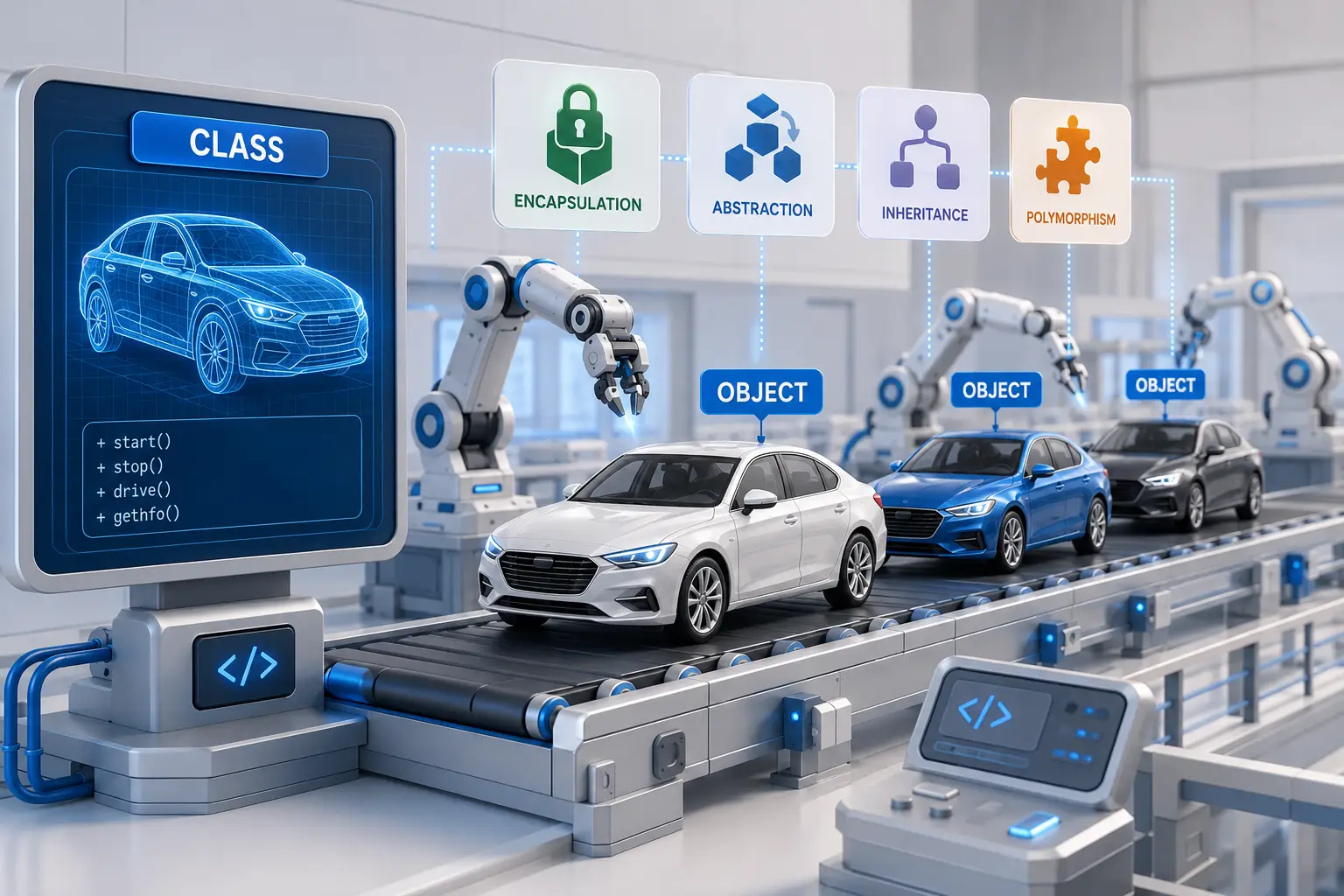
Object Oriented Programming or OOP is a way of designing and developing a software with the idea of "objects", combining both information and actions. Apart from writing a program as long sequences or functions, OOP organises the code by putting them into self contained units that behave like real world things. Each object has its own data (state) and method (behaviour), and objects interact with each other and create complete system. This practice makes the code less complicated even if the programs grow larger. Therefore the code is easier to understand, organise, reuse, test and maintain.
Let's think of a car factory which follows a clear structure. Every car is build using plans, assembly lines, and process that are repeated for every vehicle.
The Blueprint (OOP: Class)
Engineers create a detailed blueprint before the factory start to build any car. The blueprint is not the car itself, but it is the plan that describe exactly what is a car and what it can do. It includes the attributes of the car such as brand, model, colour, engine type, fuel type, transmission, top speed and it defines what car can do like start, stop, accelerate, brake, honk.
In OOP the blueprint is a 'class'. The class it not the actual object, it defines what the object will look like. The class cannot be driven, or it is not physical. But from the class, many real cars can be build.
The Real Car (OOP: Object)
This is the part that the factory build the real car according to the blueprint, which becomes the real object. Using the same blueprint the factory can produce different cars like,
- A blue Volkswagen Golf R with 2.0l, 4-Cylinder Turbo Petrol, with 6 speed manual, with 260km/h top-speed.
- A white BMW 320i with a 2.0l, 4-Cylinder Turbo Petrol, 8-speed automatic, and a 230 km/h top-speed.
- A red Tesla Model S with Tri-Motor All-Wheel Drive, with direct automatic drive, and a 322 km/h top-speed.
But they all follow the same structure defined by the class.
Projecting the Internal Components and Hide the Complexity (OOP: Encapsulation)
In a real car the internal components (connecting wires, fuel lines, sensors,...) and engine are not exposed. It is enclosed inside the car body. Usually you do not have to reach to the engine with your hand control it (unless your car is broken!), instead you use the steering wheel, gear stick, dashboard buttons, paddles. These are your interface to the internal systems of the car.
Encapsulation means bundling data and methods together inside an object while protecting their internal details. We interact with an object’s state through safe methods rather than allowing other parts of the program to change it directly. This makes the code more secure, prevents accidental mistakes, and makes it easier to maintain. In Java, encapsulation is mainly achieved using access modifiers such as 'private', 'default', 'protected', and, 'public', along with the public methods called getters and setters.
Driving without Knowing the Mechanics (OOP: Abstraction)
When you drive a car, have you ever thought about the mechanism behind it? Probably not. If you did, driving would become difficult, because every time you press the accelerator, you would have to think about how the fuel pump works, how each piston moves, whether the ignition system is functioning, and how the battery supports the system. But in reality, you do not worry about those internal details. You only care that when you press the accelerator, the car speeds up, when you press the brake, it slows down, and when you turn the steering wheel, the car changes direction. Instead of dealing with a complex mechanism, you simply interact with a simple interface.
In OOP, abstraction means hiding complex details and showing only what is necessary. Users of your code do not need to understand how a method works internally. They only need to know what it does and how to use it. This reduces complexity and makes your code much easier to work with.
Building a new car model from a existing one (OOP: Inheritance)
Imagine a car factory that begins with one basic car model, called the standard Car. From this single model, the factory creates many specialised versions, such as a sedan, an SUV, a sports car, or an electric vehicle. Each new model keeps the core features of the original car, but also brings something unique of its own. A sports car might have a more powerful engine, an SUV might have higher ground clearance, and an electric vehicle might use a different kind of engine. This is the idea behind inheritance in OOP.
In OOP, inheritance allows one class to reuse and extend another class. You start with a parent class that contains the general features shared by all cars. Then, child classes can inherit those common features and add their own specialised behaviour. This makes the code cleaner, reduces repetition, and helps create a well organised hierarchy of related objects.
Many Forms of the Same Action (OOP: Polymorphism)
Now think about the action of moving. Every car can move, but not all cars move in the same way. A sports car accelerates quickly, an SUV moves more slowly, and an electric car may move smoothly and silently. Even though they all perform the same basic action, the way they perform it is different. That is polymorphism.
In OOP, polymorphism means that the same method name can behave differently depending on the object that uses it. For example, an 'accelerate()' action may work one way in a sports car and another way in an SUV. This gives developers more flexibility because they can use the same interface for different types of objects, while each object responds in its own proper way.
Why OOP Matters in a Real Software
Just like a car factory is more efficient than building cars randomly, OOP is more efficient than writing code as long, unorganised functions. OOP helps you,
Organise the code into logical, reusable units.
Avoid repeating the same code many times.
Make changes to one part without breaking other parts.
Build systems that are easier to test and debug.
Create software that grows cleanly as it becomes more complex.
OOP is not just a programming technique. It is a way of thinking about software as a world of interacting objects, just like the real world is a world of interacting things.