A Message in the Dark: Voyager 1 Reaches One Light-Day from Home
Voyager 1 reaches one light-day distance, marking humanity’s farthest journey into interstellar space.
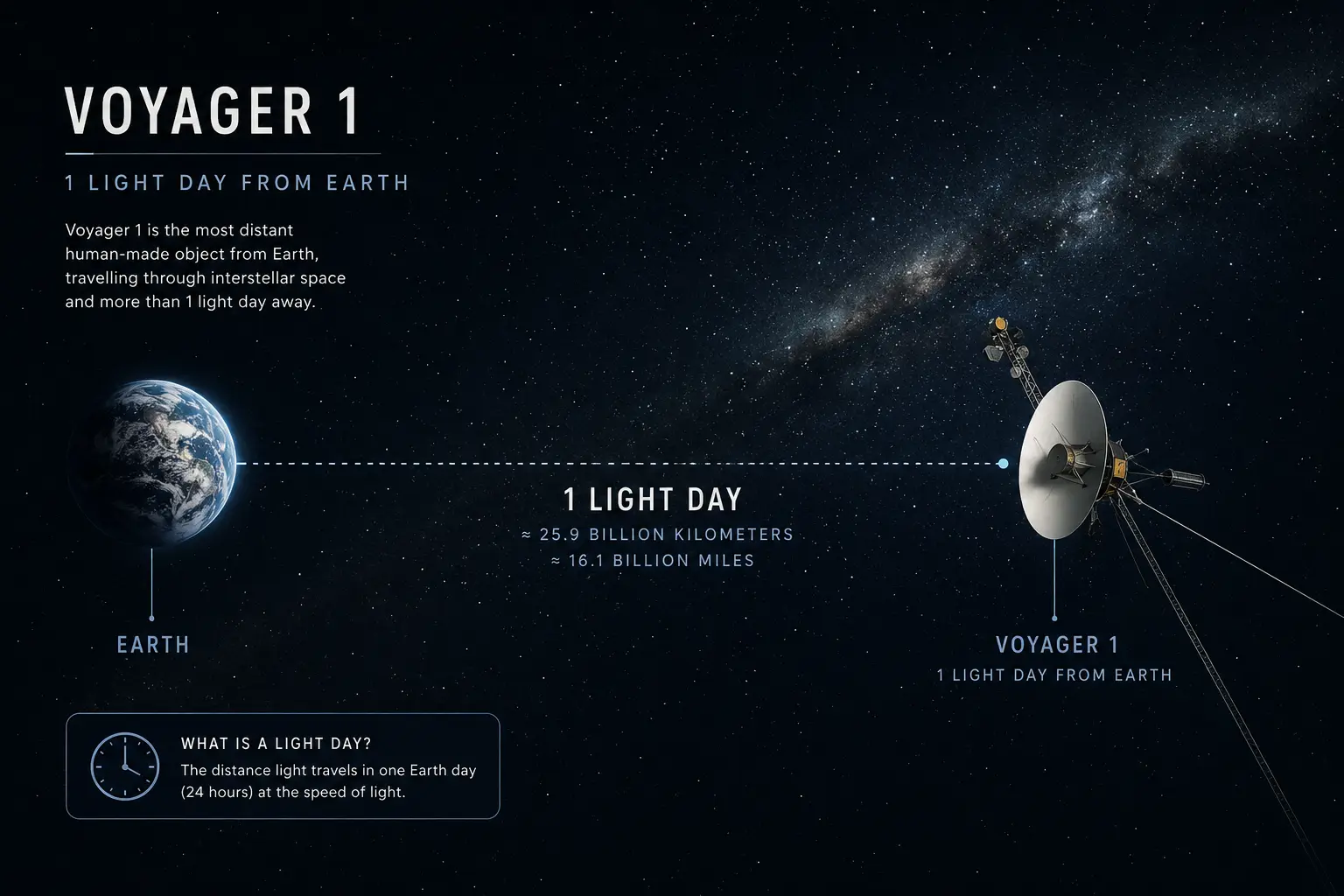
On September 5, 1977, NASA (the National Aeronautics and Space Administration) launched "Voyager 1", intending to observe the outer planets of our solar system, especially Jupiter and Saturn because the scientists wanted to study their atmospheres, rings and moons in detail.
In November 2026, after traveling about 25.9 billion kilometers in about 18,000 days since its launch, Voyager 1 will reach a historic distance of one light day from the Earth. This fact feels fascinating until you realise that at this point, a signal traveling at the speed of light, 299,792,458 meters per second (299,792.5 km/s), will take a full 24 hours to reach the spacecraft.
Voyager 1 discover several important things during its early mission. At Jupiter, it captured detailed images of the Great Red Spot and observed active volcanoes on one of Jupiter's moons Io. That was the first time a volcanic activity was observed beyond the Earth. On the other hand at Saturn, it observed the complex structure of the rings and revealed new knowledge about one of Saturn's moons, Titan, including its thick atmosphere. These discoveries expanded our knowledge about the planetary systems.
In 1980, Voyager 1 completed its planetary mission and continued its journey outward. Then it was assigned to the Voyager Interstellar Mission. The primary aim was to study the outer boundary of the Sun's influence. After about 12,700 days of travel, in August 2012, Voyager 1 crossed the heliopause (the boundary where the Sun’s solar wind loses its power and interstellar space begins) and officially entered interstellar space, making history. Voyager 1 is the first man made object to reach this region, and later Voyager 2 crossed the heliopause in November 2018 at a different location.
Even today, Voyager 1 is sending scientific data which are measured by its instruments including cameras, spectrometers, magnetometers, a plasma wave detector, and particle detectors. Each instrument designed to study planets, magnetic fields, radiation and the space environment around and beyond the solar system.
However, the communication has become increasingly difficult due to its current distance from the Earth. Imagine you have a long distance friend and you have to communicate with them, but one message may take 24 hours to reach one end to the other. I hope you most probably get frustrated and at the same time you have to be careful about what you communicate because if anything goes wrong it will take more than 48 hours to fix. Now you can imaging the frustration scientists have, and how careful they are.
Far from the Sun, Voyager 1 survives on three Radioisotope Thermoelectric Generators (RTG) or nuclear batteries. These "nuclear batteries" convert heat from the radioactive decay of Plutonium-238 into electricity, keeping the spacecraft alive in deep space. But this power source is slowly fading, and it is said that the generators lose roughly 4 watts of power every year and it is expected that most instruments will stop functioning by 2030.
Voyager 1 is famous for carrying the Golden Record, a symbolic message from Earth. The Golden Record includes sounds, music, and images representing human life and culture.
Reaching one light day after almost five decades shows how fascinating the humanity has been in science and technology and the limits, and on the other hand the vast scale of the Universe. Voyager 1 continues its silent and alone journey, moving deeper into the unknown space and carrying with it the story of the Earth.